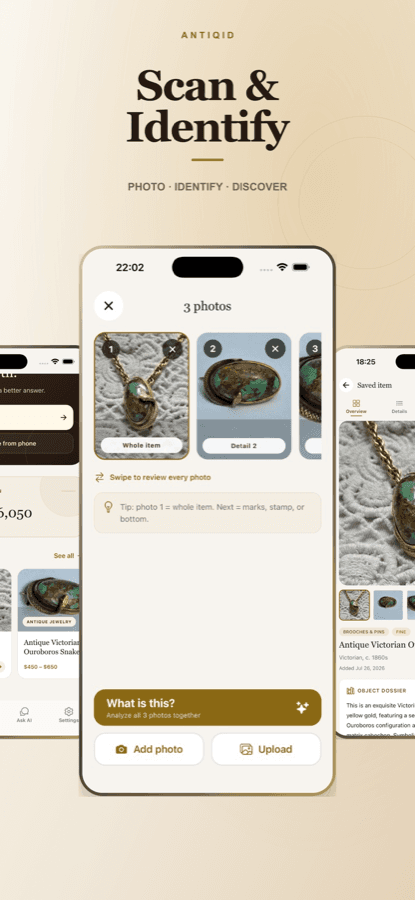
Built for the objects you actually own
Most 'antique identifier' apps stop at a generic label — 'porcelain vase' or 'silver spoon' — and hope you don't ask more. AntiqID is designed for the follow-up questions: which factory, which decade, which market this belongs in, what to photograph to strengthen the match.
You start with a single photo. If the AI needs more, it says exactly what — a raking-light shot of a mark, the base, or the joinery. Answers cite the sources they used, so you can verify them yourself.
How the identifier reads a photo
The model looks at three layers at once: the object as a whole (silhouette, proportion, joinery), the surface (patina, wear, glaze chemistry), and the marks (maker, assay, painter). Weighing them together beats matching a single feature.
When a photo is too dark, too flat or too far away, the app tells you and offers a specific reshoot. That's why the same object photographed twice can move from a rough era to a specific factory and decade.
What the answer contains
Every identification includes what it is, an era window, likely origin, materials, why the AI thinks so, and what would change the answer. When applicable it adds a conservative resale range and links to comparable pieces.
- Named object with function and typology
- Era or decade with a plain-language range
- Origin, region and — when supported — maker/factory
- Materials and construction details
- Confidence, evidence and what to photograph next
- Value range with cited comparables when they exist
Objects the identifier handles well
AntiqID is trained on the objects people actually bring — ceramics, porcelain, silver, brass, bronze, glass, furniture with hardware, lamps, clocks, watches, tools, coins, medals, textiles, small paintings, prints, books, jewellery and toys.
Where it says 'not sure'
Very worn or repainted objects, tribal and folk pieces without documented lineages, and modern reproductions of famous factories are the honest limits. AntiqID flags these instead of guessing, which is exactly the behaviour a serious owner or reseller needs.
Privacy while identifying
Your saved collection lives on your device. Photos are only sent to Google Gemini when you ask for an identification, and the app doesn't build a server-side archive of your objects.
Pillar guide
Identify antiques cluster
Start at home with a clear method, then branch into jewelry, furniture, porcelain, or silver. The photo guide and identifier app close the loop.
hub
Identify valuable antiques at home
Practical checklist: marks, materials, construction, when to get help.
guide
Identify antiques from a photo
Whole object first, then marks, base, and damage close-ups.
guide
Antique jewelry identification
Marks, karat, construction, and period style tells.
guide
Antique furniture identification
Wood, joinery, styles, drop-leaf tables, and hardware.
guide
Porcelain & pottery marks
Meissen, Dresden, Limoges, and factory mark reading.
guide
Identify antique clocks by style
Mantel, wall, longcase — case style vs movement clues.
comparison
Best antique identifier app
What to look for: sources, confidence, privacy, multi-photo.
Pillar guide
Antique jewelry cluster
Jewelry is the highest-demand identify topic. Use this hub for marks and style, then jump to silver hallmarks or the at-home method.
Pillar guide
Antique furniture cluster
Furniture ID is about wood, joints, and style — not a single stamp. Start with the hub, then deepen with value and photo tips.
hub
How to identify antique wood furniture
Joinery, wood, finishes, drop-leaf, dressers, and chairs.
guide
Antique drop-leaf tables
Hinges, gate-leg vs drop-leaf, wood and period tells.
guide
Identify antiques at home
Home checklist before you call an appraiser.
guide
How much is my antique worth?
Conservative resale ranges without auction hype.
guide
Photograph for identification
Full piece, joinery, hardware, and underside shots.
FAQ
Do I need multiple photos?+
A single clear photo is enough for many objects. For ambiguous pieces — worn marks, reissues, unmarked wood — a second raking-light photo of the mark or joinery greatly improves the answer.
Does it work for tribal or folk objects?+
Sometimes. Documented cultures and forms are covered well; obscure regional objects are flagged with lower confidence and a note about what a museum specialist would need to see.
Is it good for repro and fake detection?+
For well-known factories AntiqID compares proportions and marks and calls out common reproduction tells. For unknown makers it stays cautious, which is the correct answer.
Do the value ranges come from real markets?+
Yes. AntiqID cites recent sold-comparable listings and appraisal sources; when live comparables are thin, it says so and gives a wider range.
Identify your first object in a minute
Download AntiqID, photograph one piece, and see what a grounded AI identification actually reads like.
Available on the App Store